PAGES
OUR PHONES
LABELS
- AIRLINES GUIDELINES BOARDING PETS (20)
- AMERICAN AIRLINES (7)
- ARTICLES and TIPS (94)
- Animal welfare (9)
- Argentina (15)
- Australia (2)
- BOARDING SERVICES (29)
- Belarus (1)
- Brazilian Institute of Environment and Renewable Natural Resources (1)
- Buenos Aires (15)
- CAT'S CARE (10)
- Canada (1)
- Cargo Shipment (3)
- China (5)
- Continental Airlines (9)
- Corporate Relocation (5)
- Costa Rica (2)
- Customs Fee (1)
- DAFF (1)
- DOGS AND CATS (46)
- Delta Air Lines (3)
- European Union (2)
- FLIGHT STATUS (2)
- FLIGHTS INFORMATION (22)
- Ferret (1)
- France (1)
- Fédération Cynologique Internationale (1)
- HOLISTIC MEDICINE (15)
- Hotel Room Pet Care (3)
- IPATA (11)
- Import Rabbit Pet (5)
- Indonesia (1)
- International Air Transport Association (3)
- International Pet Transport (58)
- Ireland (2)
- Jamaica (1)
- Japan (2)
- LAW AND PETS (10)
- Microchip (4)
- Ministro Pistarini International Airport (8)
- NATURAL FOOD FOR PETS (9)
- NATURAL SUPPLEMENTS FOR PETS (7)
- Northwest Airlines (1)
- PET BEHAVIORAL (18)
- PET INSURANCE (3)
- PET TAXI (6)
- PET TRAINING (19)
- PET'S ADOPTION (11)
- PET'S CARE (59)
- PET'S LOVERS (45)
- PET-FRIENDLY HOTEL IN SOUTH AMERICA (20)
- PETS FLIGHT STATUS (5)
- PETS FRIENDLY HOTELS IN NORTH AMERICA (5)
- PETS QUARANTINE ALTERNATIVES (12)
- PETS RELOCATION (130)
- PETSVENTURA (110)
- Pet Relocation (5)
- Pet Shipping to Brazil (6)
- Pet Travel Scheme (6)
- Pet passport (10)
- SENASA (2)
- Saudi Arabia (2)
- Service dog (4)
- Shipping fighting dogs (1)
- Singapore (1)
- South Africa (1)
- Southwest Airline (1)
- TAM AIRLINE (2)
- TRANSPORTING SERVICES (51)
- Tanzania (1)
- Traveling Pet Argentina (3)
- Traveling Pet Australia (2)
- Traveling Pet New Zealand (2)
- Traveling Pet USA (1)
- Traveling with Pets (3)
- US Airways (1)
- United Airlines (7)
- United Arab Emirates (1)
- United Kingdom (2)
- United States Department of Agriculture (2)
- Uzbekistan Airways (1)
- Vietnam (1)
- Virgin Islands (1)
- defra (4)
Every animal has a unique personality and temperament
Dogs Need Guidance not Empathy
Are There Signs of Depression in Your Pet?
Faced with any pet behavioral issues, please contact Jim Anderson, Pet Behaviorist.
Contact By Email: http://www.petsventura.blogspot.com.ar/p/contact-us.html
Dog Fear of Strangers

CLICKER TRAINING FOR BEGINNERS
CLICKER TRAINING
The click lets your animal know it has completed the task successfully and a reward is coming. If you make the mistake of inadvertently clicking, be sure to still follow with a treat or other reinforces. One click equals one treat. The rate of reward may be very high in the beginning and that’s fine (15- 20 clicks per minute). This is where practice becomes necessary.
Stop Your Dog From Barking
- Barking is OK until the dog is told to "Stop Barking." Each time your dog barks, after two or three barking, praise your dog for sounding the alarm. Then order your dog, "Stop Barking." At the same time, you can provide your dog especially tasty food treat in front of its nose. Praise her continuously "Good girl, stop barking, what a good quiet dog you are, good dog . . ." After 3 seconds of no barking, let her have the treat. The next time she barks, require her to stop barking for 5 seconds before she gets the treat. Each time she is told to stop barking and succeeds, she will be rewarded. Within a single training session, you can teach your dog to stop barking for up to 1 or 2 minutes. This is major progress, because whatever set off her barking in the first place is history, and she is likely to be quiet until the next disturbance.
- Sometimes a spray of water in the face will do the trick. You must find something that will immediately make your dog stop barking. As soon as your dog stops barking, even for just a tenth of a second, you must immediately and instantly reward her. After adequate repetitions your dog will learn the meaning of the command, "Stop Barking," and you will no longer need your training props (water, treats, etc.)
STOP SUBMISSIVE URINATION IN DOGS
- Warmly compliment your dog for positive behavior such as going outside to urinate
- Greet your dog calmly from a standing position. When you bend down and your dog lies down to say hi, he will be showing more submissive behavior which reinforces other behaviors of this nature such as submissive urination.
- Avoid direct eye to eye contact when you first see your dog upon returning home. This can be intimidating to a timid pooch and precipitate submissive behavior.
- Don’t grab and hug your dog when you walk into a room where submissive urination has occurred. Once again, a shy pup may see this as an act of dominance and the result will be submissive urination.
- If submissive urination occurs at a specific time, such as before sleeping, or just before you go out, try limiting your dog’s water drinking at that time. Be careful not to deprive your dog’s water access for more than just a very short period of time as water is essential to his well being.
- Don’t make a big deal out of your return home. The excitement in your voice and greeting can be a signal to your dog that he should submit to your entrance and respond with submissive urination. Enter the room calmly and without fanfare. Just let your dog come to you. He will relax once he knows this is not a time for him to respond to dominant behavior by submissive urination
- Join a group dog training class. Submissive urination is not a house training issue. By helping your develop other behaviors such as responding to basic commands of sit, stay, come, fetch and others you will be reinforcing positive behaviors and can then divert your dog from submissive urination when that moment occurs.
- Never scold or punish your dog who is displaying submissive urination behavior. This will only reinforce the behavior and in the case of punishment can be inhumane and unlawful as well. Just say “NO”, in the popular vernacular of many anti drug use advocates. Do this in a firm but calm voice each time.
PET’S LOVE AT THE FIRST SIGHT…
“There are things that cannot be explained. No words to describe or answers to give. Feelings, gestures, dreams and smiles. The soul understands. The mouth is quiet.”
AMOR A LA PRIMERA VISTA...
“Hay cosas que no se explican. No hay palabras para describirlas o respuestas para dar. Sentimientos, gestos, sueños y sonrisas. El alma entiende y la boca calla.”
PUPPY POTTY TRAINING TIPS
CRATE TRAINNING YOUR PUPPY
Crate train your puppy early as it will benefit both the puppy and its owner. The puppy will use the crate as its home or bed for rest and security, if trained properly.
It could also assist you in your potty training too.
Why a dog crate?
A crate will be taken as a comfortable and secured home for your puppy if you crate train it properly. It would not soil it since it is going to rest and sleep there, and you can also use it to potty train your dog too.
Introduce the puppy into the crate by luring it in with some toy or a treat or, worst case; just carry the little cute puppy into it. You can place an old T-shirt or towel to make it more comfortable for it to rest and sleep.
You should only put the puppy into the crate when it sleeps at night and it would slowly learn to go into it for nap during the day. Or when it feels frighten in certain circumstances like heavy rain with thunder and lightning.
Eventually, it will learn that the crate is its home and a place to go to for rest and sleep, and a place where it feels secure.
The crate can also be useful if it is an indoor dog and you need to leave it alone in the house or apartment when you go out for a short while.
So what is a dog crate?
A dog crate can be a foldable metallic fence, plastic dog house, collapsible plastic or foldable portable nylon mesh crate. I would recommend that you get a big size plastic crate with a metallic door; one that can have the top half removed.
There are different sizes of crates to suit the different breeds of dogs. Your dog must be able to sit upright inside the crate and lie down comfortably across the crate. It must be able to turn around inside the crate. I would suggest that you buy the size that would fit your puppy when it has grown into an adult dog.
The crate should not be used for confinement as a punishment for some wrongdoing. For example , it should not be used to punish your dog when it does not listen to your commands during training.
SEPARATION ANXIETY IN DOGS
What is separation anxiety?
A dog with separation anxiety becomes abnormally anxious when separated from his owner. The severity of the anxiety and behavior the dog exhibits varies from animal to animal. Separation anxiety can result in problematic behaviors such as: whining, pacing, salivation, barking, howling, scratching, chewing, digging, urinating or defecating, or destroying personal items or household objects.
What can I do about separation anxiety?
If you suspect your dog is suffering from severe separation anxiety - especially if he is harming himself or your property - please consult with us to find the best method of treatment. Quite often leaving a radio on will help ease the dog and drown out ‘strange’ sounds. For milder cases, you may want to try one or more of the following tips to help reduce your dog's anxiety: More exercise - Go for more walks and throw the ball more often. Tired dogs are naturally less anxious. Soften your departures & returns - Keep your departures and returns low-keyed and unexciting. Don’t speak to the dog when you leave and don’t go nuts over him when you return! Gradually lengthen periods of your absence - Stage several short departures/arrivals throughout the day, gradually lengthening each absence as your dog adjusts. Finally, try the Pheromone Plug-In - Many dog owners have seen a remarkable improvement in their dog's anxiety with a relatively new product, the Comfort Zone Plug-In. Inserted in any wall outlet, and odourless to humans, it releases Dog Appeasing Pheromones (DAPs) in the air throughout the entire room. Mimicking a mother dog’s natural pheromones, it reduces and prevents stress-related behavior such as barking, whining, chewing, and soiling.
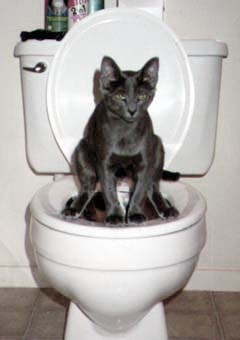
TOILET-TRAIN YOUR CAT
Begin by moving the cat's current litter box from wherever it is to one side of the toilet. Make sure he knows where it is and uses it. Next put something — a stack of newspapers, a phone book, a cardboard box — under the litter box to raise it, say, about an inch. Get another box or phone book and raise it a little higher. Continue this process until the bottom of the litter box is level with the top of the toilet seat![]()
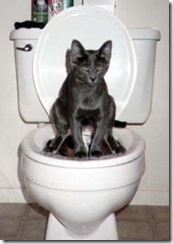
At the beginning of this process, your cat could just step into the box; later he began jumping up into it, until at some point he probably started jumping up onto the toilet seat first and stepping into the box from there. You've been diligently keeping the lid up and the seat down, of course, so by now your cat is thoroughly familiar with tromping around on the open toilet.
Lift the seat on your toilet and measure the inside diameter of the top of the bowl at its widest point. Venture forth and buy a metal mixing bowl of that diameter. Do not substitute a plastic bowl. A plastic bowl will not support the cat's weight and will bend, dropping into the toilet bowl and spilling litter everywhere, not to mention startling hell out of the cat.
Now you move the litter box over so that it's sitting directly over the toilet seat. Take away the stack of phone books or whatever.
Take away the litter box entirely. Nestle the metal mixing bowl inside the toilet bowl and lower the seat. Fill the bowl with about two inches of litter
Naturally, any humans using the toilet at this point will want to remove the metal bowl prior to their own use and replace it afterward. The next week or two the whole process is likely to be something of an annoyance; if you begin to think it's not worth it, just remember that you will never have to clean a litter box again.
Watch your cat using the bathroom in the metal bowl. Count the number of feet he gets up on the toilet seat.
Catch him beginning to use the toilet as much of the time as possible and show him where his feet are supposed to go. Just lift them right out of the bowl and place them on the seat. If he starts out with three or, heaven forbid, all four feet in the bowl, just get the front two feet out first. Praise him all over the place every time he completes the activity in this position.
When he is regularly using the toilet with his front feet, begin lifting a hind foot out and placing it on the seat outside the front paws. Be persistent. Move that foot four times in a row if you have to, until it stays there. Praise and/or treat.
Repeat with the other hind foot, until your cat learns to balance in that squat. Once he's getting all four feet regularly on the seat, it's all downhill from here.
Begin reducing the litter in the bowl. Go as fast as he'll feel comfortable with, because as the litter decreases, the odor increases. You'll want to be home at this point so that you can praise him and dump out the contents of the bowl immediately after he's finished, to minimize both the smell and the possibility that your cat, in a confused attempt to minimize the smell on his own, tries to cover it up with litter that no longer exists and ends up tracking unpleasantness into the rest of the house.
By the time you're down to a token teaspoonful of litter in the bottom of the bowl, your next-door neighbors will probably be aware of the precise instant your cat has used the toilet. This is as bad as it gets. The next time you rinse out the metal bowl, put a little bit of water in the bottom. Increase the water level each time, just as you decreased the litter level
Once the water in the mixing bowl is a couple of inches deep and your cat is comfortable with the whole thing, you get to perform the last bit of magic. Take the mixing bowl away, leaving the bare toilet.
HOW TO HELP YOUR DOGS TO COPE WITH FIREWORKS
- Stay at home with your dog or drive it to the countryside and return when the fireworks have finished.
- Keep your dog indoors. Avoid late afternoon and evening walks. Try to give the last chance for a pee after the fireworks have stopped.
- Close windows to reduce the bangs and shut curtains and keep bright lights on so that associated flashes can't be seen.
- Play loud music with a beat to reduce the impact of any bangs that occur outside.
- Try to keep your dog relaxed by playing with toys before the fireworks start and keep playing throughout.
- Don't reassure your dog if it looks apprehensive or frightened because this will accidentally increase its fear by giving it attention when it is a state of distress.
- If your dog is in a relaxed state when fireworks occur give it attention to reward it.
- Ignore fireworks yourself.
- Maintain your dog's access to any area it has already learn to go to as a means of coping.
- Don't move your dog if it is sheltering somewhere because you could cause it to become defensive.
- Pray for rain.
DO DOGS SPEAK?
Dogs learn to respond to different sounds, body language (movements and gestures) and facial expressions. Animals instinctively communicate with other dogs and this is not something they learn from humans. So, a dog from Argentina will understand a dog from England, and so on. They will, however, have difficulty understanding the English or Spanish spoken language, or any other language, since every language has different sounds associated with the words in the language.
As a dog trainer for the last 35 years, I have not encountered difficulty in communicating with dogs, including dogs coming from other countries where the spoken language has been different than my own. Based on both my knowledge and experience with dog training as well as in linguistic professional, I can confidently say that I a dog’s level of understanding is based on our ability to learn how to communicate in their language by using our own voice, body language (movements) and facial expressions.
Search This Blog
WELCOME!
Our Services include:
- International air pet transport:
- Domestic air pet transport
- Door to door services our specialty
- Local pet delivery and boarding
- Sale of pet cages and travel crates
- Import clearance agents
- Export pet travel documentation
- FREE Quotes and Advice
Specialized In South America